
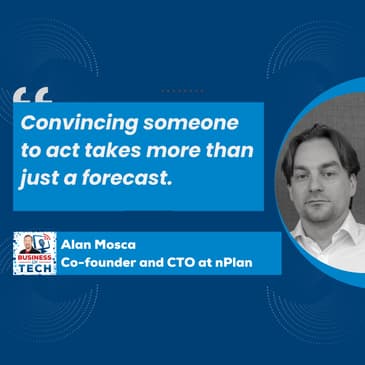
Alan Mosca, CTO of nPlan, discusses the transformative role of machine learning in construction project management. nPlan leverages historical data from large construction projects to create forecasts that help improve project execution. By analyzing how past projects were completed, NPLAN aims to shift the traditional mindset of project planning, which often relies on rigid schedules with fixed dates. Instead, the company focuses on modeling uncertainty and exploring various scenarios to better prepare for potential deviations from the plan.
The conversation delves into the core components of nPlan's technology, distinguishing between machine learning, algorithmic AI, and agentic AI. Mosca emphasizes that while machine learning is used to predict outcomes based on historical data, the real innovation lies in automating workflows to handle the complexity of large projects. This automation allows project managers to explore thousands of execution options, which would be impossible to analyze manually. The integration of AI agents into project management processes is framed as a means to enhance human decision-making rather than replace it.
Mosca also highlights the importance of transparency in machine learning models, noting that decision-making in uncertain environments requires a probabilistic approach. He draws parallels to weather forecasting, where probabilities guide expectations rather than definitive outcomes. This approach helps project managers understand the likelihood of various scenarios, enabling them to make informed decisions based on the data provided by nPlan's systems.
Finally, Mosca reflects on the challenges of implementing technology in the construction industry, particularly the need to motivate stakeholders to act on forecasts. He points out that human behavior often requires more than just data; personal experiences and contextual factors play a significant role in decision-making. By supporting project managers with AI-driven insights while respecting the nuances of human interaction, nPlan aims to foster better project outcomes in an industry that is often resistant to change.
💼 All Our Sponsors
MSP Radio is supported by our partners:
ABC Solutions · CometBackup · Firetail · Guardz · HaloPSA · LogMeIn · Mailprotector · OpenText · Pax8 · Proofpoint · Rythmz · ScalePad · TimeZest · Transit AI · USecure
Supporting the IT services community through insights, analysis, and transparency.
🚀 Join Business of Tech Plus
Get exclusive access to investigative reports, vendor analysis, leadership briefings, and more.
👉 https://businessof.tech/plus
🎧 Subscribe to the Business of Tech
Want the show on your favorite podcast app or prefer the written versions of each story?
📲 https://www.businessof.tech/subscribe
📰 Story Links & Sources
Looking for the links from today’s stories?
Every episode script — with full source links — is posted at:
🎙 Want to Be a Guest?
Pitch your story or appear on Business of Tech: Daily 10-Minute IT Services Insights:
💬 https://www.podmatch.com/hostdetailpreview/businessoftech
🔗 Follow Business of Tech
LinkedIn: https://www.linkedin.com/company/28908079
YouTube: https://youtube.com/mspradio
Bluesky: https://bsky.app/profile/businessof.tech
Instagram: https://www.instagram.com/mspradio
TikTok: https://www.tiktok.com/@businessoftech
Facebook: https://www.facebook.com/mspradionews
Hosted by Simplecast, an AdsWizz company. See pcm.adswizz.com for information about our collection and use of personal data for advertising.
[00:00:02] We're going to dig a little bit into the difference between AI and Machine Learning. We're going to talk a little bit about the way data matters and is it the data or the algorithm, and we're going to learn how you can impact project management. Alan Mosca, he is the CTO of NPLAN, joins me on this bonus episode of the Business of Tech.
[00:00:22] This episode is supported by Syncro. Syncro, the integrated remote monitoring and management and professional services automation platform, is designed for mid-sized and growing managed service providers. Its latest innovations include an AI-powered smart ticket management system with automatic ticket classifications, guided resolution steps using pre-approved scripts, and a natural language smart search function.
[00:00:46] These tools streamline ticket handling and improve response times. Discover more at SynchroMSP.com. Well, Alan, welcome to the show. Thank you so much for having me, Dave. So I want to dive right in, but in order to set the stage a little bit, I think listeners need to know a little bit about what NPLAN does. You guys use machine learning to analyze construction projects and then use that data to help implement projects better.
[00:01:15] Tell me a little bit more about what that is and how it works. Yeah, sounds crazy, right? Effectively, if you look at any construction project above $10 million a spend, which is pretty much almost anything nowadays, you'll have some form of planning involved. And you'd hope that even home renovations and these kinds of things have enough planning. But let's assume that there's a threshold above which we need to be.
[00:01:40] And these plans don't necessarily get executed as they were planned. And that's effectively what NPLAN was built for is let's take the plans for these construction projects and the mega projects and the infrastructure projects, look at how they've been executed over the last N years, and then build a forecast of how's it going to go. And that in itself is just incredibly valuable data that we've been able to produce.
[00:02:10] And we started in 2017, so we've got a lot of data now to back it up. Now, if you were thinking about NPLAN as like a product, I would describe it, and I want to make sure I'm getting this right, as a specifically focused on construction scheduling project planner. In that I wouldn't put this in the same bucket as like Microsoft Project, which is just a generic toolkit. You're very focused on a particular vertical. Is that fair or am I limiting it in some way that is artificial?
[00:02:40] So, it is fair. The only limitation that we've seen is the actual data set. So what we do should work on anything that has been actually created in Microsoft Project. The limitation is the data that we've been able to find, which includes how did those projects end and how were they completed. But there's no theoretical reason why it shouldn't work for IT projects, for example. Okay.
[00:03:06] But the reason I wanted to set that stage is because I wanted to get a little bit of understanding of the value, the way you perceive it. Is it like the data or is it the algorithmic model on top of that? Or is it like the interface? Like, talk to me a little bit about when, if I'm saying like, what's the core value of NPLAN? Like, how would you describe it of those components? The core value is, I describe it as a shift in the way that we think about projects.
[00:03:32] So right now, when you're planning, and sadly this is true, when you're planning a $20 billion project that lasts seven years, someone will create a schedule that has 50 to 100,000 activities in it. And those activities will have defined dates all the way out to 2032. And I'll say, we will finish and commission this project, whatever it is, let's say it's a railway. We'll have the first trains running on the 21st of October, 2032.
[00:04:02] And that is just, there's a lot of problems with thinking in that way. So what we do is we model the uncertainty on top of that schedule, and then start thinking about what are all the alternative possibilities. So that we then look at what could actually happen, right? So what's going to send my plan sideways? There's a famous quote, no, no plan survives contact with the enemy, right?
[00:04:27] And that's basically what we're looking for is what are all the different ways that this plan can deviate. And if we start from the end points that we want, what are all the different versions of the plan that lead to good outcomes? And it's a completely different way of thinking that is based around the uncertainty of execution. And that's really what we're pushing. The reality of how it actually materializes is through SAS software and AI agents that help the scheduling.
[00:04:55] And the industry is actually called project controls, which is a subset of project management and helping project controls professionals, use this way of thinking to improve the outcomes of the project. I think the other version of that is with the boxer that said, the plan goes out the window, we get punched in the face. So there's both versions of that. Like, but what's interesting is the forecasts are based on historical data.
[00:05:20] So how do you make sure that the system accounts for innovations or shift in industry practices that haven't happened yet? Yeah, there's, there's a lot of work that we've done on the machine learning modeling side to be able to have models that know what they don't know.
[00:05:38] So as well as being able to be very good at creating forecasts about things that we've seen in our dataset and those models has trained on, there will also be identification of opportunities where then the model will say, I actually haven't seen this in my training. So then I'm going to assign it larger uncertainties, but uncertainties that go to the left where the left is early rather than just uncertainty of things going sideways.
[00:06:07] Uh, and that has actually helped, uh, helped a lot of, uh, a lot of, uh, companies during COVID for example, which for everybody was causing delays and actually in construction created a lot of opportunities as well, because all of a sudden you didn't need to close the roads or it wasn't going to be a problem if you had to close a road. Um, and so I created all these, these new opportunities. Now I want to dive slightly into the tech here, but mostly because I want to break down a little bit of the marketing buzz.
[00:06:37] We're using the word AI to describe what you're doing because that fits well into what most understand. But my suspicion is this is much more machine learning than it is artificial intelligence. Clarify for me a little bit of like the, the approach and what, you know, what, what it really is putting it to make sure we're putting aside the marketing terms. Yeah. Yeah. There are three components. So one, you're absolutely right. Machine learning to predict what is going to happen. So you put the schedule in and you receive a forecast. That's step one.
[00:07:06] Step two is then call it algorithmic AI or old style AI about finding all different possible scenarios. And then step three is more agentic where we take all these workflows and we started automating them so that you can actually achieve the scale.
[00:07:25] So one of the problems in being able to look at, you know, what are 5,000 options of executing a $10 billion project is that you don't have enough humans on the planet to be able to think at that scale. And in reality, what we, what we need to do is automate the workflows as much as possible. And that's where the agents have come in. Okay. So that makes, that makes sense to me.
[00:07:51] So I would think you've learned a lot about transparency and understanding the decision-making process of the algorithm because you've got to trust its decisions. Tell me a little bit about like what you learned through the process of developing this about the way to effectively use machine learning for decision-making and still keep that transparency. Yeah. Yeah. Yeah. Yeah. And it's, it's incredibly hard, right? Because machine learning is mostly about black box.
[00:08:17] There are some things that you can infer about why certain, certain output outputs look that way, but there's a fundamental insight which came out of our research team, which is all decisions that you make are about the future and future. The future is inherently completely uncertain, uh, even at a physics level. So what you need to be able to do is to have machine learning models that give you a probabilistic view. And this is what we do in weather forecasting.
[00:08:46] And it's probably the only discipline that does this very well and very rigorously where we say, if tomorrow there's a probability of rain, that is let's say 80%, whether it rains tomorrow or not, doesn't tell us whether we were right or not. What we have to do is take all the times that we've given it 80% probability and count how many times did it rain. And that number has to be 80%.
[00:09:14] So we ended up having to develop methods to make machine learning models do that in their forecasts. And it's, it's, how do you report on that to the user in order to make sure that they are able to be, to make smart decisions based on probability? Yeah, it's, it's super difficult, right? It's super difficult because humans are not built to think in this way.
[00:09:37] So what we end up doing, and this is where like the, like old school AI comes in, where we build pathways through the probability networks to create individual stories, right? This is why you think about tens of thousands of possible outcomes, and then look at the ones that we like and look at what was the simulation saying along the way. And then we take that information from 5,000, 10,000 simulations.
[00:10:04] You put them usually into an LLM and you say like, find the common things that guide towards these good outcomes in the simulations. And that's how you get stories out of, well, you know, if you're building a bridge and you have a toll plaza to build, you might as well build the bridge and the toll plaza at the same time. Which is something very simple, but may come out only through simulation. Gotcha. Okay.
[00:10:34] Now, the other thing that would be interesting is, so you've been at this for a little while, you've been doing it since 2017. I would suspect something has surprised you over the course of this, and you've learned something really insightful. Like what? And I can tell from your face right away, like there's a thing, like what's the thing you've learned the most that like surprised you over this journey? The thing that is most surprising to me is that actually building the tech was not the hard part.
[00:10:58] The hard part, even if you have a forecast that tells you exactly what's going to happen, convincing someone to do something about it takes so much more information than just the forecast. And you have to build so many more stories on top of it so that you're creating that incentive to take initiative.
[00:11:19] And the example that I use for this is just think about how many people in the world still smoke, despite it being way more than proven that smoking will shorten your life. Right. Um, and it doesn't matter how many times you show the data.
[00:11:38] The thing that springs people into action is some sort of personal event, whereas like, oh, I couldn't go up the stairs without running out of breath is like one of the more benign ones, which then triggers them into wanting to stop smoking. Um, and that's to me, like the human behavioral factors have been the most surprising. And perhaps if you look at it from the outside, they should not be that surprising, but they're also the hardest ones to, to work with.
[00:12:02] And in fact, you've come out sort of said that you support the idea of AI supporting, not replacing human decision-making and project management. So how does that manifest itself in the way that you're implementing the product? Yeah. The way it manifests is so the agents support our users, which are project managers, project directors, um, who will have certain agendas, right?
[00:12:27] So you describe the agenda, like this, this week I have to produce a 200 page report for the DOT. And in that report, I wanted to have this particular story because we're running out of funding for the project or whatever the story might be. Right. And that's where those things give goals to the agents. And so it is important for us to preserve that.
[00:12:52] Uh, whereas you could come at it from a different angle and say, just let the agents do everything, but it's going to miss those, those parts of, I'm going to call them lightheartedly politics in a sense, right? Politics context, what is happening that may not be documented in all the project documentation that we actually need to be aware of. And what are the goals of the organization?
[00:13:19] Well, interestingly, I mean, if we get to the actual definition of politics, it's not what we apply in governmental sense. It's actually the negotiation between humans, right? To get something like that's the, that's the, the raw what we're talking about. So I guess the, the interesting thing then to sort of, as we're wrapping here, I want to get your take on, we're all throwing around the idea of AI agents and you just brought it up. Yeah. I could make an argument that that's just what we're really doing is just informed robotic process automation. Uh, that's a simplified version of it.
[00:13:49] And by the way, everyone that I talked to has a different definition of what an AI agent is. Talk to me a little bit about what you're, how you're defining AI agents and what your expectation of them is. Yeah. I think, I think you've hit the nail on the head, to be honest, like Rebecca, robotic process automation is agents is grandfather. Right.
[00:14:12] Um, because what we're going for is we're looking at what are the human processes that are long repetitive that need to be scaled up. Right. Why would we look at RPA in the past exactly for these same reasons, right? We'd look at something that's a little bit boring. We need to do it a thousand times. We wish you could do it 25,000 times or 25 million times.
[00:14:35] So let's find a way of scaling it up and automating it and have our life be a little bit less boring, uh, and focus on value add. Right. Uh, and I think agents fit exactly in that box. My definition of an agent is an entity that can make decisions about performing actions within a certain level of autonomy.
[00:15:00] So this is where I distinguish from example, a chat assistant is not an agent because it doesn't have the agency. Right. That's which I think it's literally in the word. Um, and so being able to call the tools to fulfill perhaps even loosely defined goals, which is where I, I think we're going to go next is the goals are going to become way more loosely defined.
[00:15:27] And we're going to give more autonomy and hopefully a lot of things will scale up, scale up even more. Well, I think you've also just unlocked what the value is on services providers is talking about it, finding those, those use cases and identifying applying. Alan Mosca is the co-founder and chief technology officer of N plan, where he leads the development of AI systems that predict risk and outcomes in major construction and infrastructure projects.
[00:15:52] It's got a background in quantitative finance and deep learning, bringing a unique blend of technical expertise and practical innovation to project forecasting. Alan, if people are interested in learning more, what's the best way to get in touch? Best way to get in touch is on LinkedIn. Um, otherwise, uh, on our website and plan.io, there's a contact form if you're interested in the products. Awesome. Well, thanks for joining me today. Thank you for having me. Thanks so much.
[00:16:20] The business of tech is written and produced by me, Dave Sobel under ethics guidelines posted at business of dot tech. If you've enjoyed the show, make sure you've subscribed or followed on your favorite platform. It's free and helps directly. Give us a review too. If you want to support the show, visit patrion.com slash MSP radio, and you'll get access to content early or by our, why do we care? Merch at business of dot tech.
[00:16:48] Have a question you want answered. We take listener questions, send them in ideally as a voice memo or video to question at MSP radio.com. I answer listener questions live on our Wednesday live show on YouTube and LinkedIn. If you've got a comment or a thought on a story, put it in the comments. If you're on YouTube or reach out on LinkedIn, if you're listening to the podcast. And if you want to advertise on the show, visit MSP radio.com slash engage. Once again, thanks for listening.
[00:17:18] And I will talk to you again on our next episode. Part of the MSP radio network.