
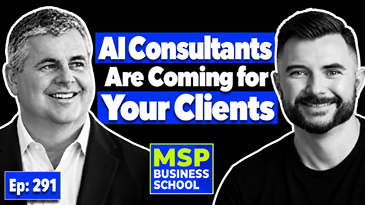

In this engaging episode of MSP Business School, host Brian Doyle welcomes Kyle Christensen, founder of Empath, to explore the rapidly evolving landscape of AI in the world of MSPs. With a rich background that includes time at Geek Squad and turning a small MSP into a hyperscaler, Kyle brings deep insights into both the opportunities and challenges that AI presents to the MSP sector. Listeners are introduced to the concept that while AI holds potential for incredible business transformation, the current scenario sees many businesses—including MSPs themselves—still in experimental phases of AI adoption.
As the conversation progresses, Kyle and Brian discuss the shift from a fear-driven sales approach to one motivated by FOMO. They stress how important it is for MSPs to establish a consultative relationship with their clients and adapt to each client's unique business processes for successful AI integration. The episode highlights the necessity of embracing AI not just as a tool but as a service-oriented opportunity that can lead to deeper client relationships and enhanced business value. They caution against setting unrealistic expectations or avoiding the full utilization of AI due to perceived complexities.
Key Takeaways:
- Embrace AI with Curiosity: Both MSPs and their clients are still learning and experimenting with AI. Viewing AI as a field of exploration rather than immediate mastery can foster innovation.
- Shift from FUD to FOMO: Transitioning from fear-driven sales to leveraging clients' fear of missing out can create a more thriving business environment.
- Consultative Approach: The future success of MSPs lies in consulting, listening, and understanding individual client needs to integrate AI effectively into their processes.
- Monetizing Readiness Assessments: Properly executed readiness assessments, which might take several weeks, are crucial and should be a paid service.
- Growing Advisory Roles: There is a ripe opportunity for MSPs to strengthen their advisory roles amidst the AI transformation, preventing AI-exclusive consultants from taking over client relationships.
Guest Name: Kyle Christensen
LinkedIn page: https://www.linkedin.com/in/kylechx/
Company: Empath
Company Website: https://empathmsp.com/
Show Website: https://mspbusinessschool.com/
Host Brian Doyle: https://www.linkedin.com/in/briandoylevciotoolbox/
Sponsor vCIOToolbox: https://vciotoolbox.com
Listen to MSP Business School on the Fox and Crow Group Your IT Podcasts Network!
[00:00:09] Hey everyone, welcome to the latest installment of MSP Business School. As always, I'm Brian Doyle joining you today. And we've got a guest that's probably very familiar to many people out there and definitely brings a lot of entertainment to the conversation, which is fun too. I want to welcome Kyle Christensen from Empath.
[00:00:28] Kyle Christensen Thank you. Thank you for having me. It's kind of crazy you've been doing this all this whole time. I've never been on and it's it's funny on how in this channel we see each other all the time. We say hi, and then we never actually get a chance to like shoot the shit. Kyle Christensen Yeah, and we and it's also amazing in this channel that we're we're closing in on 300 episodes and we probably only had maybe a dozen people on twice, which also tells you how many people there are in the channel.
[00:00:54] Kyle Christensen And conversations with it. It's really wrought with some great thought leaders, is it not? Kyle Christensen It's a lot of hot air too, right? If you really think about it. Kyle Christensen It definitely goes both ways. Kyle Christensen Are people working? People trying it? Kyle Christensen Yeah, I'm impressed with everybody that has more time than me to really be good stewards of their LinkedIn. I tend to be a binge guy on that. Kyle Christensen You know, I posted about this yesterday. I kind of fell out of love with LinkedIn.
[00:01:24] Kyle Christensen It's a little bit the last like six to nine months. And it made me have this existential curiosity to just like video killed the radio star will AI kill the social media? Kyle Christensen Yeah, it's a there is a lot of AI driven conversation out there. And you can tell from some of the people that have been on a long time when their voice changed, right? And really when a lot of what they were posting changed.
[00:01:52] Kyle Christensen It's a tough time to be authentic some in some ways out in the world of the AI engines. Kyle Christensen Yeah, it's tough. And you know, it's tough for I think a weird, interesting conversational reason, because we love the idea of removing friction from our lives and making things easier. So the appeal of AI and social media is very much that, oh, the blank page is defeated faster.
[00:02:18] Kyle Christensen Well, does the bank blank page being defeated faster remove the curiosity or the creativity that would have had a better canvas to begin with? And you're now just iterating what the blank page created. So then your voice changes, like you said. Kyle Christensen Yeah, I've tried to take the approach as much as possible to write it out first and then just ask it to punch it up because I certainly didn't go to school for writing. So that's where it can be a help for me in the world of LinkedIn.
[00:02:44] Kyle Christensen But before we get too deep down the avenue of AI, because I know that's going to be a big part of our conversation today. Why don't you share a little bit about your background, Kyle, and you know how you ended up in the crazy world of MSP? Kyle Christensen Yeah, it's a long story because I've been in the channel since 2002. I started at a very small IT company. Kyle Christensen I hear your hands on as great as mine, man. Kyle Christensen Yeah, because I was 15 when I got recruited into this channel. So I'm getting there. It's starting to get a little salt in there.
[00:03:15] Kyle Christensen But the small IT company that I came from, some of you might have heard of it, Geek Squad. Kyle Christensen Never. Kyle Christensen No, yeah, right? Many could call it the largest IT company that's ever existed when you really think of the scope that they had. I actually got hired by Geek Squad directly. So this was pre-Best Buy acquisition. Best Buy acquired us. And as a 16-year-old kid, I got a call from Robert Stevens saying,
[00:03:42] hey, Best Buy just acquired us. Do you want to travel around where your parents let you fly out to Minnesota? And we got to build all these stores within a store. So real early on, I got shoved into this world of building out multiple locations and regions, which then turned into the turnaround because some stores would be misperforming and they would send me in there to go clean it up. Kyle Christensen And in 2009, we acquired a big MSP called Mindshift.
[00:04:11] And it was during that acquisition that I got familiar because they sent me to do some of the due diligence or just the learning, really. And I met a bunch of MSPs and I was like, oh, this is kind of cool. And little did I know I was making chump change at Best Buy. They were paying me like a 16-year-old kid. At that point, I was 20-something. And an MSP owner offered me basically double of what I was making at Best Buy. And I said, sure, I'll go run your MSP.
[00:04:39] And over the next 10 years after that, I turned around a couple of MSPs. One of them, we became a hyperscaler. So we went from about $2 million to $20 million in about three and a half, four years. That's a big job. Based off of that foundation. Yeah, it was. So that signature bald spot that I have is from the anxiety and stress of growing an MSP back. That's amazing. And then from there, built a consulting firm. We had over 1,500 MSPs at the consulting firm and exited that in 22.
[00:05:09] And then now I'm building Empath. And Empath is quite an organization. You're really bringing some of the best talent into that company, but also with a huge sense of humor. That's the part I think a lot of people really gravitate to. It's like, hey, here's some guys that actually have lived the life, understand what it's all about, and they can bring a little joy to my day too. So I got to give you guys a lot for that. Dean has put out some crazy stuff. I got to admit, when I see something from him, I do stop.
[00:05:37] Yeah, Dean is a personality in himself. And so what's funny is that whole Spicy Monday topic was something that was him and I both created around the same time. And then he ran with it. And I'm like, dude, that is yours. Like at this point, I don't need an association with it anymore because he has become the master of the hot take. But yeah, no. And you build a company where people want to work. It's kind of crazy, the text messages we get to the people.
[00:06:06] It's probably one of the coolest things that we've accomplished of anything. But beyond that, there is one person at our company, Joey, who comes out with some of the best marketing content that we have. Don't give Dean any credit for that because that is Joey's domain. Anytime you see me in a leopard skin bikini. Yeah. Anytime you see me in an AI generated leopard skin bikini, that is because of one Joey on our team.
[00:06:31] Well, I enjoyed Dean's video when he was sitting in the lawn chair outside, just talking at a very slow pace. Yes. With his cocktail. It totally brought me back to some of the bad 70s TV I've seen before. It was great. But let's kind of shift gears a little bit. Before we got started today, we were talking a little bit about AI. And we know all MSPs are at a different stage of life from where they are in their AI journey.
[00:07:01] Some have not even started really utilizing it full bore inside their businesses. Some have deployed projects. It's really one of the more interesting times where everybody wants to be an expert, but not everybody's actually executed. I'd love to get your take on what you're seeing out there, especially as somebody that's helping train the folks that are going out there and doing these projects. Yeah. If there's one definitive statement I could make is that we're all practicing. We're all dabbling.
[00:07:31] None of us. Anyone that claims to be an AI expert, I kind of laugh at it. Unless you're a mathematician that's been practicing at a university, like some big, I don't even know what the degree is in. Most of us have only been involved with AI for the last two, three years. And the whole concept of 10,000 hours to become an expert, well, we only have a maximum capacity of 1,000 hours. Right?
[00:08:01] We haven't had enough time to get that much time under our belt. No. And the one thing that is true is, and there's a couple of things that I've seen and I've kind of put out there is, even if you're 1,000 hours into your journey of being an AI expert, your customer is 10 hours into their journey. Their 10 hours are playing with Grok or ChatGPT on their phone.
[00:08:26] And the one thing I absolutely love about this new era or chapter in us as MSPs, this is the first time we are in a place where our customers are asking MSPs for something. And this is something we haven't seen, Brian. Honestly, since 2004, 2005, when the iPod came out and the iPhone came out and laptops
[00:08:55] got small and fun to use, technology hasn't hit the consumer brain in quite a while in a way that MSPs can grab onto. Where for the last 10 years, we've been conditioned to push the market, push our customers and say, you buy this cybersecurity thing. You buy this cloud thing. Try to educate them to the why and not get too deep in fear, uncertainty and doubt along the way. Right? But it is all FUD. And I hate the whole like you can't sell with FUD because it's all FUD.
[00:09:23] It's all fear or it's all uncertainty. Doubt once in a while is manipulation. But cybersecurity, you couldn't do it without fear. Cloud is all predicated on you don't want a server in your closet because it's a risk if it goes bad. Right? It's cheaper. The fear is you're overspending. So the whole like you can't, you can sell without FUD. Well, it's a little too, what's the word I'm looking for? Hopeful? Yeah.
[00:09:52] And what I told John Harden the other day was we have evolved out of the FUD era and we are in the FOMO era. And that is really a big difference, I think, with AI is it is the FOMO. I think a lot of, you know, a lot of the conversations I'm having is people feeling like they're either not yet keeping up and that people are that far in front of them that they've lapped and outpaced them. From a customer perspective, it's definitely what am I not doing that I should be doing with it? Right?
[00:10:20] And we're seeing that and it's creating, you know, I looked at Always FUD as what you're really creating is a sense of urgency, right? Well, what we're seeing is almost the reverse here. The urgency exists and now people want to know how do they get there? And depending on where we are in our journey, we may or may not know that answer. And, you know, it's interesting. I think back to the cybersecurity era and what we've been conditioned to do with our customers. The cybersecurity era, we built an MSSP at my, at FIT back in 2016, very early on.
[00:10:49] EDR didn't exist. It was you buy a SIM, you buy a network collector, you do some vol scan. And that was it. Like we had to have our own SOC. And the thing that I learned quickly around this entire concept was there is so much that the market has to learn and that the business has to wrap around productization, something that MSPs don't talk enough about, that we never listen for market demand signals.
[00:11:20] And MSPs love, I mean, how many times you could ask for a QBR template, Brian? You know, hey, can I just do a template with this? Can I do that? And I'm like, yeah, go for it. Because that's not really what we're trying to do here. And what did we do as MSPs? We have to standardize. We have to make everything the same. Nothing can be different from customer A to customer B. When it's, no, you sell stakes to customer A and customer B. But you ask them, well, how would you like it? Prepared.
[00:11:49] And I think that was the key that, and I think it's still missing with cybersecurity to this day. Today is we feel like we have to shoulder and burden 100% of the risk on behalf of the customer, regardless of our margins, regardless of the customer's opinion. And where I think this is going, and I posted on this on LinkedIn yesterday, where it's going to bite a lot of us in the ass is you cannot approach that at all with AI. And I have a key data point on that.
[00:12:19] I talked to an owner of an MSP that has 1,100 employees. I'm very good friends with them. I talked to them on the regular. They rolled out an entire AI initiative to try to standardize, to try to productize. We built this and we deployed to many. And what was interesting is as many customers as they have, Brian, they started to go, this thing we built for client A, how many of them can we actually sell it to for client B, C, D?
[00:12:49] I guess out of a percentage, how many of their, I don't remember how many thousands of customers they had. So I'm going to say it was probably under 5% as built to repeat because the reality is every business has a little bit of nuance. And for the first time, at least from my seat, what I'm seeing is we really need to be engaged with the business process owners and not just the people we've been talking to for the last 20 years. And those are some of the classic differences I'm hearing repeatedly over and over. How far was I? Exactly.
[00:13:19] It was less than 10% of their sell-through market. So if they have a thousand customers, only a hundred of them qualified to be sold this product, which means that's not how many you're going to sell. No. You're probably only going to have a 20 to 30% success ratio of that market. So of the thousand customers, two of them, you can sell this AI thing you standardized to. And it kind of opened my brain a little bit.
[00:13:46] And I kind of had that moment where I went, holy shit, there's a bad word in this channel that all MSPs are either going to have to get on board with or completely just, I mean, fall out of favor with. And guess what that word is? From my seat, I would say it's continuing to deepen the relationship, but that's not a single word. So I'm going to throw it back to you. Well, I mean, what is deepening the relationship? It's consulting. Yeah. Oh, yeah.
[00:14:14] I mean, you know, being a guy that's been around the industry now going on 30 years, we used to have to consult to sell those boxes when we were getting 20, 30% margins back in the day in order to get them to understand the why on that. And it's come back around. I mean, this is, you know, this, I call it the age of advisory. If you grab hold to this, you can really cement yourself with a client. You can build depth inside of their, um, inside of their, you know, office space that you've never gotten before.
[00:14:41] I mean, you should be able to spread your wings and now get six or seven allies in a business where you used to have two, because now you can talk to them about AI business process, what's mundane, and really kind of start growing the relationship. But, you know, I'm off my soapbox. This is your time. No, no, no. I'm on the same soapbox as you. And, you know, it's where it's unfortunate.
[00:15:06] And I want to, I want to, I'm going to sidetrack for a second is this whole idea of you need to sell them a managed service agreement before you do anything with them is said by people that have for, well, one, have never done it before, or two, have forgotten the first 10 years of running their MSP where all they ever did was build relationships, build relationships off of TNM work and projects and conversations and awkward lunches.
[00:15:36] There's this, this, uh, idea that floats out there of the only, the only way you get a new customer is if they buy an MSP agreement on day one. And I'm sitting there going like, uh, have you ever signed a deal for three, four, $5,000 a month expense for someone you've never even seen them do work for before? Kyle, I talked about it all the time. One of the first projects we ever did when we started our IT services company, my partner
[00:16:02] went out and installed a router on the Friday after Thanksgiving for a customer. And I said, dude, I feel real bad because I'm taking the day off and you're working. And he said, no, no, you never know where to lead. And we ended up doing $15,000 a month with that customer within a year, you know? And it just started with that small project that in the, get your foot in the door and then you launched and it did take awkward lunches. And showing up. And I think that's one of the other things that's changed over time.
[00:16:29] You know, we want to do everything like this over Zoom, but there is something about showing up at somebody's office, seeing them face to face and slapping their hand, especially if you work in the same locale. Yeah, no, completely. And we can have a whole separate side conversation on the importance of human to human interaction. But I think the point we're driving across is you're going to have to build trust. You're going to have to build confidence in the trust that they have.
[00:16:56] And also, your customer's dabbling as much as you are. They don't want to just, and this kind of comes full circle to the conversation I wanted to have, which is if we approach AI like we approached cybersecurity, your customer's going to come to you and go, Brian, hey, I'm kind of concerned that we're not on this AI thing and that my competitors are getting on it. And I need to do this.
[00:17:23] I was listening to a podcast, and on that podcast, they were talking about how they reduced the time to quote by 20%, 30%. It went from two hours to 20 minutes by using AI inside of HubSpot. Can you help us do that? And if we use our previous conditioned response that we learned in cybersecurity, it's Mr. Customer, yes, we can do that for you. However, we need to do X, Y, Z, W, A, B, C.
[00:17:51] We need to make sure you're standardized. We need to make sure you're protected. We need to make sure all of your risks are mitigated. We need to make sure that no one has access to the button. Risk, risk, risk, risk, risk, foot, foot, foot, foot, foot. And in 18 months, we can finally do it after $30,000 investment that you give me right away because it's the only way I'm going to touch it. I'm going to judge you, by the way, if you tell me no to this, possibly fire you because I'm that proud and egotistical. Then I can approach your question about getting your AI and HubSpot working correct.
[00:18:17] And it's not the approach that obviously needs to be taken. And certainly, it's not going to get you the experience you need along the way to figure out how to do these projects and get that repetitive muscle going. You know, while I can agree with the can't standardize and sell one product across all of our customers, just like everything we do, there's kind of a core approach that lives there. And then it's just where does it kind of fly out from there?
[00:18:42] Well, it's the and John Harden has a great product that he released called Lemhi, where it's this kind of like, how do you baby step your way into some type of AI adoption? And it does some guardrails and some risk management and security foundationals. But him and I were on a podcast recently where we both kind of agreed that we're kind of hypocritical in the sense that as MSPs, we've all went out and bought some $20, $100 clot and GPT licenses and dabbled with it.
[00:19:12] Yet, for some reason, our customers can't do that. Why can't we allow them to do that and hold their hand on the way? And this is why I put so much of a gamble in Empath when we built out our new product, Empath Grow, you probably have all seen it, to where if we are afraid of what the customer is going to do with AI, they're going to buy it anyway. I mean, shadow IT is something we never fixed. Honestly, it's probably something we can't fix. So why wouldn't we enable people to use AI?
[00:19:41] And not ethically or secure. Those are too proverse. They're too big of a concept for a standard end user. Like, how do we just make it to where they use it well? Like, hey, Mr. Customer, if you're going to buy 20 seats of clot, let's just make sure people know how to use chat. They know how to use cohort. They know what a skill is. They know how to connect an MCP server. Like, why is that not the first step that we can make money? We can make a lot of money. Set up some of the basic guardrails so you at least know you're doing your best and trying
[00:20:11] to secure them. But it's also going to open up the doors of possibility with them, right? Because now they're playing with it. Now they're getting an understanding of what they see. But they're going to get stuck when it gets a little too technical for them. And then it'll be, how do we get to do this with my finance data or that with my HR data? You know, whatever the case may be. Well, it becomes consultative. And there's an MSP out there. I love the man to death where he's doing something very interesting.
[00:20:40] What their approach to it is, is they need to embrace the curiosity of AI. And because it's a FOMO motion, they're going to say yes to whatever you tell them, as long as you're not going to go off the deep end. So what he's starting to do is he's creating committees at his customers. Because this is that whole lean manufacturing or agile kind of ideology of, let's figure out
[00:21:06] how everyone right now could use AI to identify where we can apply it. And then that curiosity creates a bunch of internal champions at your customer that then go, oh, let's spend money on this AI project that's big and expensive because we all want it. And now you're not just talking to the decision maker. You're talking to all of their employees that are going, Brian, I'm going to be an upset employee if you do not pay my MSP or our MSP to set this up for us.
[00:21:35] And you're spot on with that. Sorry, go ahead. No, that's why I go back to the consultative word. That's a consultative approach. And what's fantastic and where we might miss the mark on this. This is what we always wanted VCIOs to be and could never figure out. And I fear that we will completely miss the opportunity. And AI consultants are just going to come in and grab all that revenue. Well, I can tell you we're trying on our part to not let that happen.
[00:22:05] And we're building similar tools into our application to try to help folks get familiar with how they can potentially do that at the application level. If I can enable you, why can't you enable your customer in a similar manner, right? And those are the types of things that spur that consulting. And yeah, I agree. Like there's never been a better time for the VCIO and even the VCSOs peripherally to be able to step up and really start having stronger conversations where before they were kind of
[00:22:34] mired in that, you know, renewal conversation that unfortunately was thrust upon them. I mean, I have my own personal opinions of them on that, but we'll move on. Well, I've, and this is no reflection of what you guys are all doing. I was never a huge fan of this VCIO and VCSO type language because it's so highbrow. It talks over our customers when at the end of the day, our customers are our bosses. We work for them.
[00:23:02] So why is being a consultant or being an advisor or why can that not be the 4A? And it's, it's funny because in other industries, being a consultant is like, Ooh, did you work for McKinsey? Did you look for Deloitte? I mean, these are giant freaking companies. Consultant is not a bad word. No, if anything, they're looked at almost as superheroes that wear capes in some cases. They're the ones that can turn a shit situation no matter how big into something that's manageable.
[00:23:32] I mean, there's books on this crap. There's frameworks on this. Kaizen, Lean, all of this stuff. And where, um, where I was going with it is they are the ones that will have to have the time in the runway to make sure that the users have time to learn and that they have, you know, frameworks of what they're going to learn and the ability to report on where that learning brought value to that customer so that they buy more. And I agree.
[00:24:02] You know, I think, you know, in a world full of alphabet soup, the acronym kind of took over, but it really does go back to that simple concept of if you come in, gain trust, provide good advice, great things happen. And that's really what I see as the opportunity for those that sit in those VCIO roles. Forget about the title, but really just go in, build some trust, learn about the customer, listen, and good things will come out the other side. Well, and listening takes time.
[00:24:31] Uh, I know a lot of good consultants. They, they will just go to a, a client's office and they'll just sit in the sales bullpen for a week. They'll go sit in accounting for a week. Ooh, why'd you click that? Oh, tell me about this process. Tell me about that process. They'll look for the bottlenecks. It's the whole theory of constraint mindset. Go find the biggest choke point. And what's, what I love about this opportunity and where I think some of our plastic thinking
[00:25:00] or plastic thinking is going to get us in trouble is that time isn't free. That time is something that your customer, if they have a process problem, this is where the term business transformation comes into play. You are going to have to spend time to observe. This is not something you just paper whip a quote out to them and sell them something because you don't like to productize or you don't like to write complicated quotes or statements of work or project delivery plans or change orders for that matter, which don't get me
[00:25:29] on that high horse. So what you have to then unpack in all of this is we are drastically allergic these days to non-recurring revenue or to retainers. We think that it's bad revenue when that is the foray into consulting. I've always looked at AI as the project begets the governance. So the as a service comes on a back end through doing the project up front, right? But really it starts with the readiness assessment.
[00:25:58] And I'd love to get your take on this too, because right to your point, so many people are trying to find a way to do that for free. And if you really want to do a proper readiness assessment, right to what you were talking about, sitting in the bullpen, those kinds of things. It is truthfully a three to four week engagement where you have to really understand the company's business at a higher level, come out with maybe a pipeline of 12, these could be projects, and whittle it down to the top three that are going to give them the best value back for it, right?
[00:26:27] And when I tell MSPs on our side, as we're talking about how to utilize our tooling to support that, I hear, well, I can't charge my customer three to five thousand for that engagement. I can't charge them five to ten thousand. And I'm like, well, how are you going to do that for free and come out profitable the other side? Yeah, it's the fear of the MSP telling their customer they need to pay more money because they are internally, again, this goes into like the whole cybersecurity thing of I'm going to burden all the risk.
[00:26:53] Well, now you're really burdening all the risk because that customer has nothing to say no to. They have nothing to push back on if you don't go to them telling them, hey, if you want me to figure out where your business is messed up, I need to get integrated because right now all I do is look at the IT. I don't look at how your sales guys are writing quotes. I don't look at how your accounting is sending invoices. I don't look at how your warehouse is managing the inventory.
[00:27:20] And if you don't have the confidence to tell your customer if you want to do AI and you don't have an immediate need that you can tell me, then I need to figure out where the highest ROI need is, which means honestly, I need to do a full body scan. Like I literally need to sit there for three weeks and I need to look at every body cavity that you have, AKA we're going up there.
[00:27:49] That I can't, I can't prescribe without a symptom. If you can't give me the symptoms, I have to find it. And then once you have the symptoms is the quality of the data good. So we can actually give you something that matters, right? There's so much to this game and it has to be charged for. And my, you know, I think we're in the alignment there, but hopefully the MSPs are realizing it's also a great opportunity to deepen the relationship in the process. You're going to get closer. Well, you set up nasty precedents.
[00:28:16] If you give it away for free, you're setting the precedents that your time is invaluable. And by the way, I understand that this is like getting on a high horse, but it's kind of not in a way, but your time is worth something and your customer can't just call you and say, Hey, our popcorn machine doesn't work. Can you come figure out why? They have to understand, like, if it's something that I'm not contractually obligated to do, like managing your network infrastructure. Well, then I need to spend some time to understand.
[00:28:43] And this is an understanding that is, uh, I mean, let's go back to consulting firms. If I, if I went to a McKinsey or a Deloitte or a Ernst & Young and said, my business is not profitable and I don't know why they're going to go great. Here's a master service agreement with all of our hours laid out. Here is how often you will get an invoice and an update on hours. And it's your objective to say, I don't want any more.
[00:29:12] This is not for us to manage the number of hours that you will consume. We will keep you abreast. We will tell you if it's becomes a project because now we understand scope and deliverables. But at some point you're just paying me for the reports. You're paying me for the information. You're paying me like an employee going back to, we serve our customers to, to sniff out the problem. Yeah. And, um, you know, and I think if you want to boil it even a different way, it's like,
[00:29:38] you know, when you work with a trade, you have an air conditioning contract, but something goes wrong that's outside the air conditioner, but you still need to utilize that person because they also handle heating. You're going to pay out of scope there. And, you know, that's the way it works, right? They're there to diagnose. They're there to triage. When you think about the consultant, they're coming in first to figure out why you're leaking money. Then they're going to tell you how to fix it. And that's where the projects come in. Well, and you want, when you unpack that, it's a desperation that causes us to get to
[00:30:06] a lot of this because we need so badly the customer to buy this from us because we probably don't spend enough time in business development at our MSP trying to find that new customers. So the only way we grow or survive is to continuously farm our current customers. So we're so afraid of them saying no, because it's such a life blind to everything else that we try to find any way that we can make them say yes, even if that is giving away the house
[00:30:36] or doing it for extremely discounted rate. So if you go to the customer and you say, hey, if you want me to fix your sales problem with your CRM, it's going to cost you time for me to figure it out. And I might need to bring in another consultant at some point. Can't really give you a list of hours until I've defined it. Are you willing to spend 10 to 15 hours for me to figure this out? They tell you no. Cool. Don't ruin the relationship by trying to like find a way to wheel and deal. I mean, wheel and deal a little bit, but yeah, like do enough to where you go, you know what, Mr. Cresper, it sounds like you don't want it that much.
[00:31:06] I mean, sure, you can go shop it, but any AI consultant is going to sit there and tell you the exact same thing. I don't know your business. I need to figure out where the bodies are. And certainly anyone that's going to help you with transformation is going to realize and recognize the amount of time they're going to have to put into it to get it there as well. So, you know, I don't think price shopping is where this problem is going to be. It's maybe more better understanding. And then the MSP is really understanding their value. To your point earlier in this, before one of those new next generation AI, pure play AI
[00:31:35] consultants who have no MSP desires whatsoever, come in and start taking that trusted advisor position with your customer because they're delivering on what they want. Yeah. They have no shame. And honestly, they don't want to steal your MSP business because they're going, man, that's 20%. They're going, I can make 80% over here. I'm going to do that. But two other small things. Go ahead, Ted. No, I was going to say, we're getting near, well, we've gone past the end of our time.
[00:32:03] But for conversations that are a lot of fun, they tend to go a little bit longer. I do want to make sure we cover off on anything you did want to cover today. So I don't know if you've got any closing topics before we wrap up today. No, the only thing that, you know, if there's one takeaway from here, it is you don't need to be perfect because we're all trying to figure this out. And your customer's not going to judge you by not being perfect as long as you set the right expectations. And you need to have a small win for them.
[00:32:30] They need to see that AI does have value. It does match the FOMO that they have. And if you overcomplicate it, you are now the same Nick the Computer guy where you're just being the negative voice in the room when it comes to AI. And you're just going to continue to sour your relationship because they came to you excited for something and you told them, no, it's expensive. We need to do a bunch of these other things first.
[00:33:00] Find the small thing that you can do. Hopefully it's Empath Grow where we can help you train your customers how to use AI. But if it's not that and it's something else like let me just do lunch and learns or workshops and you shoulder all that time and effort. Great. At least you gave them something cheap and affordable that made them go, cool, we're using AI and I feel better that I'm not behind my competitor. Well, Kyle, this has been great. I think we could probably talk for another hour on some of this stuff. It's so easy to.
[00:33:29] But for the listener, if you want to get in touch with Kyle, we've just put up for those that are watching on YouTube, his LinkedIn address. Certainly reach out and ask more. If you want to visit Empath and learn more about some of the training that they have that they can put out to your customers, specifically around AI, please visit empathmsp.com. For those that are listening audibly, these will be in your show notes so you can, of course, see them anywhere you get your podcasts. Kyle, it was great having you on. I'm sorry it took us so long for us to make this happen.
[00:33:58] But I'm sure you'll be one of the repeat guests that come back again at some point and we can see how a year from now, how AI has been deployed, right? Let's book it. Let's book it. What's your prediction on that? Just do the two second. What's your prediction on a year from now? My prediction is that the MSPs will get through the minutia of what I got to deliver. And I think it goes right back to what you said. Pick those small projects to get out the door, gain confidence themselves in it, and then figure out the machine.
[00:34:28] I love the fact that this goes back to the whole reason I got into IT. I used to be in telecom. You sold a contract. And back in the day when I did it, you didn't come back for five years. They didn't even remember who you were. When I got into IT, the best thing was it was the gift that kept giving. There was always something new we could share with our customers. And this is like the gift they want. That is the biggest difference. So if we can figure out how to give it to them once, we're going to continue to build a pipeline and deliver.
[00:34:58] For those that don't, good luck. I mean, that's really all that can be said because this is the wave we're on right now. It's been fun. All right, Kai. Well, thank you so much for joining me today. And I'll look forward to chatting with you again soon. Right on. Thank you for having me. All right.